
Duties
Governing Boards
Healthcare organizations, whether hospitals, primary healthcare centers, specialized care centers, all need a governing body to ensure that these organizations are fulfilling their intended purpose towards their communities. Governing bodies can take the form of a board, committee, or council. The function of governance is different from the function of management. Management is responsible for running the organization while governance is responsible for making sure it is run in the right direction and in the right way. Therefore, governing bodies, guided by the organization’s purpose as stated in its mandate or bylaws, develop the strategic direction and related policies that management should follow to achieve the organization’s purpose. Furthermore, governing bodies have a monitoring function over management to make sure that progress is being achieved and that law and regulations are not breached. In other words, governing bodies are responsible for the performance and conformance of the organizations they govern. As management is accountable to governance, governing boards are also accountable and in this case to either the bodies that have put them in this position or to the wider community and its regulatory mechanisms.
Board Members
Governing boards membership is crucial in ensuring good governance within healthcare organizations and their success in delivering their purpose. Board members only attain their position of power as a group and through their collective decisions. Board members on their own have no power and should not attempt to behave in any otherwise manner. Membership of governing boards is regulated by the organization mandate or bylaws which will state whether members are elected, nominated, or appointed, or a combination of these. Membership is usually limited to a specified time period, however, it can be be repeated depending on the organization bylaws.
What is crucial for good governance is board member’s competencies and independence. Board members that bring to the board knowledge and skills related to institutional governance are more valued and effective than boards who bring nothing, even if they hold impressive positions in society. Governing boards need to have members with competencies related to a diverse set of specific and general issues. Specific competencies are those related to healthcare delivery, quality and patient safety, while general competencies are those related to strategic thinking, policy making, finance, legal, teamwork, risk, change, development, etc. Board member nomination should be guided by a a competency matrix that ensures the availability of such competencies on the governing board.
The balance between board members who hold executive position in the organization and those who are independent and from outside the organization is the second crucial point and has significant bearing on the tone within the the governing board. It is believed that a majority of internal executives on a board changes the tone from that of governance towards that of management. The net result is board involvement in operational decisions which will come at the expense of its directional function and in conflict with its monitoring function.
To ensure board effectiveness and member engagement, governing bodies are advised to hold regular orientation, education, and evaluation meetings on governance principles. Such meetings have a positive effect on board members performance and collaboration among themselves and with management.
Duties
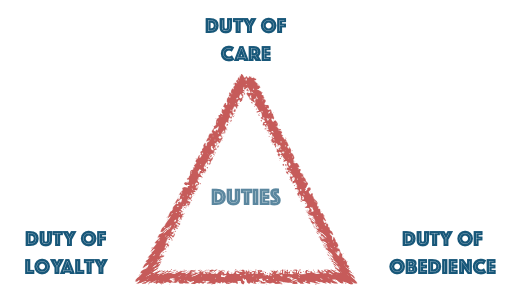
Once an individual accepts to be a member of a governing body he or she becomes legally bound to act in a manner that ensures the efficient and proper use of the organization’s resources in fulfilling its purpose. In other words, a governing body member has been entrusted with the organization wellbeing and so enters into a one way relation with the organization where he or she is obliged to meet the organization needs but not their own. Such a relation is bound by three sets of duties; Duty of Care, the Duty of Loyalty, and Duty of Obedience.
Duty of Care
Duty of care requires that a board member acts in a prudent manner that any reasonable person would when taking decisions regarding the organization. In doing so, decisions should be informed and due care has been taken to verify such information. Governing body members have the right to be equipped with the relevant data that ensures an appropriate decision and that management is obliged to offer such data to governing body members.
Duty of Loyalty
Duty of loyalty entails that board members’ decisions are taken in the interest of the organization only and are devoid of any personal gain. Situations where a conflict of interest exist, whether personal or professional, should be dealt with openly by asking the board member with potential conflict of interest to abstain from sharing in the decision making process. Also, board members should not uphold information that can put the organization in a lesser position when taking a decision. Duty of loyalty also demands confidentiality regarding any information that could weaken the organization’s position. Such issues of conflict should be regulated through policies and statements agreed and signed by all board members at time of joining the board.
Duty of Obedience
It is the duty of the board and all its members to act within the confines of the law, regulations, and organization bylaws. Furthermore, decisions should be in line with the organization’s mission and related policies and procedures. Board members should ensure that their actions and decisions are within the scope of their authority in order to avoid personal or organizational liabilities.
Understating board members’ duties is a vital initial step in practicing good governance and ensuring an organization’s wellbeing and sustainability over the long-term.
Redaing Material
Institutional Governance
-
- Ministry of Health and Population. Accreditation Executive Committee. Standards for hospitals. 2nd edition. 2013.
- The Healthy NHS Board. Principles of Good Governance. NHS. Leadership Academy. 2013.
- Principles and guidelines for governance in hospitals. CIPE and HEGTA. 2014.
Governing Boards
-
- Foundation Trust Network. The foundations of good governance. A compendium of best practice. 2nd edition. 2013.
Legal Duties
-
- Davidson P, Murdock T. Legal duties and avoiding liability: A Nonprofit board member primer [Internet]. Trustee. June 10, 2013 [cited 2016 Jun 30].
- Miller L. The legal obligations of not-for-profit boards [Internet]. AHA Great Boards Resources. [cited 2016 Jun 30].