
Good Governance
Definition
The Oxford Dictionary defines “governance” as the action or manner of governing a state, organization, etc. It also defines “govern” as to conduct policy, actions, and affairs of a state, organization or people with authority. The origins of the word governance in Latin gubernare and Greek kubernan mean “to steer”. So, governance in simple terms means how we run or direct our affairs. Governance has always been associated with politics as political governance. However, nowadays, governance is associated with all forms of activity and services. We have educational governance, financial governance, research governance, information governance, health governance, etc. Governance is here to ensure that systems, organizations or people are working towards the benefit of their owners and wider community.
Governance is different from management in that it sets direction and monitors performance while management is responsible for implementing the various activities that will lead to the achievement of the desired ends. Governance is also responsible for ensuring that activities are implemented within the boundaries of law and work ethics. Simply, governance makes sure that we are achieving the right ends without doing wrong things.
Health Governance
Healthcare is complex due to the involvement of many stakeholders in its delivery including public and private providers whether institutions or individuals. This is why several interpretations and frameworks for governance within the health sector exist.
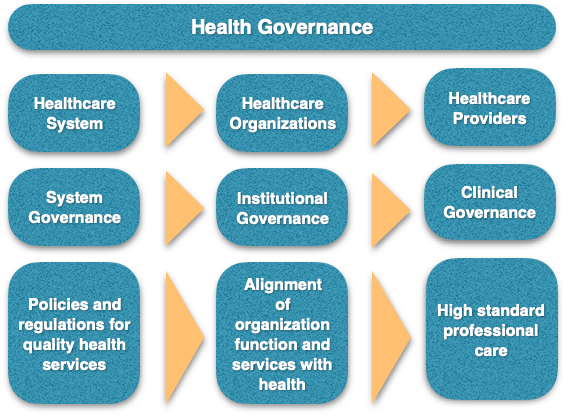
At the macro level, healthcare system governance ensures policies address population needs and accessibility to health services is adequate; this requires availability of current information, priority setting, resource allocation, and independent performance monitoring.
At the meso level, institutional governance is responsible for aligning healthcare organizations functions with national healthcare policies; this is done through appropriate strategic direction, organization policies, institutional risk management, executive oversight, service quality and safety.
At the micro level, and equally important, clinical governance ensures professional performance and accountability of healthcare providers: doctors, pharmacists, dentists, nurses, technicians; through evidence based practice, clinical audit, clinical risk management, and patient and public engagement.
These frameworks are well established and are being practiced world wide and can be grouped within an integrated framework for health governance.
Good Governance
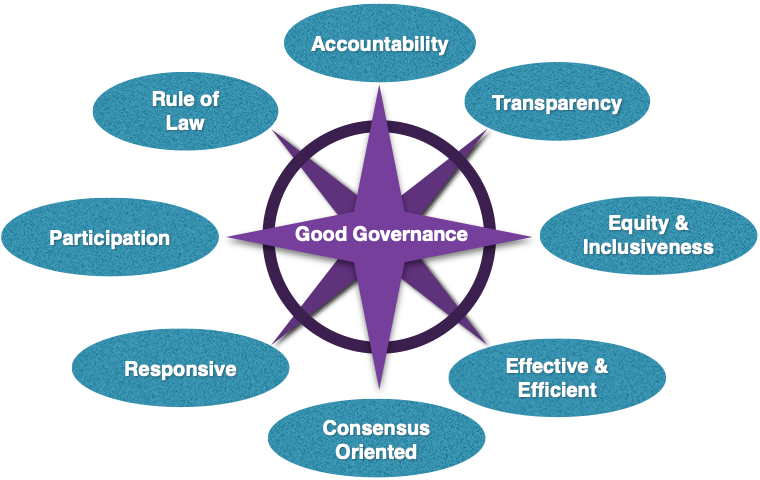
Governance is usually implemented through policy making, decision making, and foresight. All these processes should follow a group of principles that in the end will ensure good practice and outcomes. They are known as the principles of good governance as shown.
-
- Participation: All decisions taken should entail a process of engagement of all stakeholders especially those who are directly affected by them. The degree of engagement can vary from informing or consulting up to full involvement and empowerment. In the health governance special emphasis is put on patient and public engagement.
- Rule of law: Under no circumstances are the decisions to breach the boundaries of law. Furthermore, in its foresight role governance ensures that others have also not crossed the limitations put down by law.
- Accountability: A central point of governance is accountability which comes after accepting responsibility. Responsible individuals and organizations should be clear to whom they are accountable to and work towards their service. Accountability in many situations is towards our patients and wider community.
- Transparency: To ensure widest understanding all decision making processes should be clear and declared. Such understanding increases acceptance of decisions that are necessary but might have a negative impact.
- Equity and Inclusiveness: Decision makers should all the time make sure that individuals who have limited capacity regardless of its nature are given the chance to express their views and that decisions taken are not putting them in a weaker position.
- Effectiveness and Efficiency: The central objective of governance is to ensure effectiveness of services offered by individuals or organizations. Once established efforts should be directed towards efficiency by saving on unnecessary costs.
- Consensus orientation: Majority ruling although accepted as one of the forms used to reach a decision; it sometimes leaves individuals or organizations in a state of frustration. Reaching a decision through mutual consensus from all parties involved may have better sustainable outcomes . This of course requires that all parties involved are ready to compromise for the benefit of all.
- Responsive: To ensure relevance of decisions taken, responsible individuals, should respond to stakeholders needs in a timely manner. In doing so, they also fulfill their accountability towards them and the wider community.
Reading Material
System Governance
-
- Brinkerhoff D, Bossert T. Health governance: Concepts, experience and programing options. 2008.
- Kickbush I, Gleicher D. Governance for health in the 21st century. World Health Organization, Europe. 2012.
- Siddiqi S, et al. Framework for assessing governance of the health system in developing countries: Gateway to good governance. Health Policy. 2009;90:13-25.
Institutional Governance
-
- The Healthy NHS Board. Principles of Good Governance. NHS Leadership Academy. 2013
- Principles and guidelines for governance in hospitals. CIPE and HEGTA. 2014
Clinical Governance
-
- Starey N. What is clinical governance? Bandolier. 2001.
- Clinical Governance. A Guide for Primary Health Organizations. bpacNZ. 2005
Good Governance
-
- United Nations Economic and Social Commission for Asia and the Pacific. What is good governance? 2009.